July 26, 2009

Brining cucumbers.

I have really been feeling good about all of my food-based projects. I enjoy all of the researchand experimentation I have been doing - and with resources like:
and
I am learning so much.
Time to try pickles. In my research I have found that there are many different pickling recipes out there. There are the traditional fermented cucumber in a ten percent brine solution. Then there are the "easy" recipes - basically, cucumbers in a jar with vinegar solutions. There are also the transitional recipes that mix traditional brining fermentation with jarring in vinegar solutions.
I, being most interested in traditional methods, chose to try fermenting/brining. Brining preserves food by anaerobic fermentation, which, by producing lactic acid, achieves the correct pH to destroy toxic bacteria. Sounds fun.
Starting with an antique crock that I recently ran across at an antique store. I paid about $40, which I thought was very reasonably price considering the condition of the glaze (crack free). When I got home and some quick research told me that Love Field Potteries in Dallas, Texas went out of business in 1948. Neat.


Test fitted with a cake pan.

I poured in a gallon of water and placed an egg in it. The egg, as I learned, is an easy measure of salinity - stir in your pickling salt and when the egg floats to the top the ratio is right (do not forget to remove the egg).

IMG_9898

Then I put my fresh, washed baby cucumbers and placed a perfect-fitting pyrex baking dish lid on top of the cukes (upside-down to avoid air bubbles) to keep them below the surface. A weight might be needed to help hold them down. I used a bowl with some water in it.

IMG_9900

To lid the crock, I used my handled pie dish and then tied it all up in an old flour sack to keep out dust and bugs. I tucked it way away, back in a low linen closet.
The day after I started, I added about a cup of salt to help maintatin the correct salinity.
Every few days I check the cukes for scum. While it forms naturally on the surface of the solution during the process, scum destroys the acidity that you are trying to maintain during the fermentation process and, if left unchecked, results in cucumber spoilage. And we certainly do not want that.
Now, we wait.
jon.

July 21, 2009

Pickled jalapeños.

Saturday morning I woke up early (considering the night before), and I took my friend Erika (and my hangover) to Froberg's farm. It was her first visit and I did my best to show her around. She took lots of photographs and will likely have something to say about the experience soon - she has in mind that this is the beginning of "Farm Tour," which I am totally in for.
While we were there, I picked up more strawberries, okra, eggs, and - you guessed it - jalapeños. They looked so good; Erika caught me lingering and suggested that I might could pickle some. Sold.


I did not have a specific pickled jalapeños recipe so I started with a generic recipe of water, vinegar, and salt. I added some of my pickling spice mixture and some sugar to (maybe) soften the burn a touch.

Pickled jalapeños:

1 pounds fresh jalapeños.
3 cups white vinegar.
3 cups water.
3 tablespoons kosher salt.
3 tablespoons raw turbinado sugar.
3 tablespoons pickling spice.
4 crushed cloves of garlic.

Start by piercing each pepper with a fork several times - this will allow the pickling juices to get inside and the hot to get out.
In a medium saucepan, bring to boil your vinegar and water with the rest of the ingredients. Reduce and simmer for five minutes.


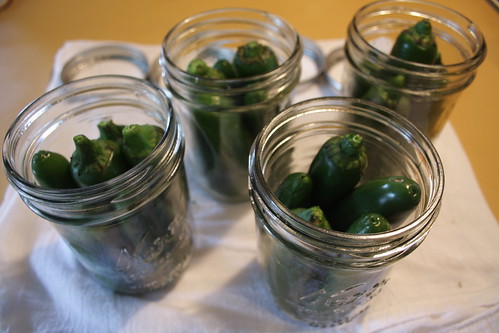
Pack the jalapeños into your sterilized jars - I only managed about five peppers per pint jar.
Pour the vinegar solution into each jar - dividing the bay leaves and garlic - leaving an inch of headspace.
Lid the (clean-rimmed) jars and process in a boiling water bath for 35 minutes. Let sit for at least a week for maximum seasoning.
The sugar darkened the vinegar more that usual which makes for a dramatic looking jar of peppers.


My mouth is watering over these already. That is all.

jon.

July 18, 2009

Pickled okra.

I think okra is pretty fantastic. Did you know it is believed to have originated in the Ethiopian Highlands? Or that it is considered a fruit on the plant but a vegetable once removed? How about that the okra pods bloom into a hibiscus-looking flower?

IMG_9456

I have loved okra as long as I can remember. Fried was my favorite when I was a kid, but these days I enjoy it most in its fresher forms. I love it in gumbo and canh chua chay - especially when left as whole pods.
Pickled is good too - which is why we are here today.

Spicy Pickled Okra:

4 pounds young, small to medium okra pods
4 serrano peppers, halved
4 teaspoons mustard seeds
8 sprigs fresh dill
4 cloves of garlic
2 teaspoons whole white peppercorns
2 teaspoons whole cumin seeds
2 teaspoons whole coriander seeds
2 teaspoons fennel seeds
1/2 cup kosher salt
4 cups white vinegar
4 cups water

Start by washing the okra and trimming the stem (if needed). Be nice to your okra because it does bruise easily.
In a medium saucepan, bring to boil the vinegar, water and salt.
Then, in each of your sterilized jars, place one halved serrano pepper, one teaspoon mustard seeds, two springs of dill, a clove of garlic, white peppercorns, cumin seeds, corriander seeds, and fennel seeds. Pack the okra in the jars, like so:

IMG_9314

By now your vinegar should be boiling, so the remove the pan from heat and pour the mixture into each jar, leaving about a quarter inch of space. Be sure there is no air trapped down in the okra.
Process the jars in a boiling water bath.

IMG_9323

***

Several people have recently asked me about the timeline in which these pickled goods are ready. The answer is that it is flexible. You can eat the okra right away, but to get the maximum benefits of the herb and spices, I think, you should wait two to three weeks. I know - it is hard to be patient.
Make and enjoy. That is all.

jon.

July 14, 2009

Pickled eggs.


I love eggs. I love pickles. So, what comes next should come as no surprise:

Pickled eggs are hard-boiled and soaked in a solution of vinegar, salt, spices, and other seasonings.
For my eggs, I decided to use a simple, hand-me-down pickling spice mixture:

2 tablespoons whole allspice.
2 bay leaves.
1 cinnamon stick.
5 cloves.
2 tablespoons coriander seeds.
2 tablespoons ground ginger.
1/4 cup mustard seeds.
2 tablespoon dried red pepper flakes.

To help cut costs, I followed the advice of a friend, and took advantage of the bulk spice section at my local Central Market. The value is amazing - I got more than enough spices for my recipe, all for about a dollar.
Start by boiling a dozen eggs. Twelve minutes at a simmer is the key. Run under cool water for a few minutes finishing by filling the pan and adding ice. Set aside.


The number of eggs per quart will vary by size.

Next, combine your pickling solution:

1 tablespoon pickling spice.
2 teaspoon salt.
3 cups white vinegar.
1 cup water.
Heat the mixture to near boiling in a medium saucepan and simmer for five minutes.
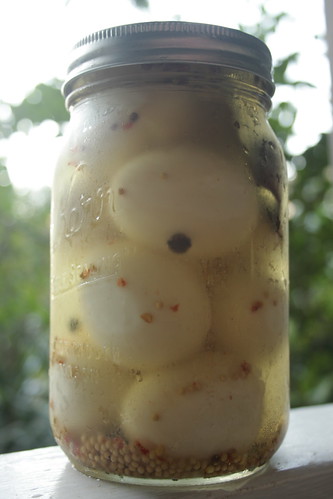
While simmering, peel your eggs and loosely pack in a hot sterilized jar. Pour the hot pickling solution (spices included) over the eggs.
Wipe the rim of the jar and secure the lid - finger tight is good. Process jar(s) in a boiling water bath for 15 minutes.
The eggs are ready for serving when the pickling solution has seasoned all parts of the egg - two to four weeks should do it.


Sweet pickled perfection.

I am too impatient to wait for these batches to be taste tested, so I will just keep trying different recipes (I have several more I want to try), but I think we need to have a tasting... thing. Perhaps August 1st?
That is all.
jon.

July 12, 2009

Strawberry Preserves.

Despite a ridiculously late start yesterday, I made it to Froberg's just before they closed. Lucky for me (and you) they still had strawberries.
The recipe for my preserves is very basic, which is a good place to start - this is my first time after all.

Strawberry Preserves:

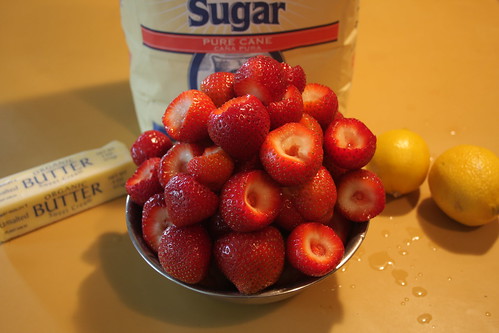
2 pounds fresh strawberries.
4 1/2 cups sugar.
2 lemons (juice only).


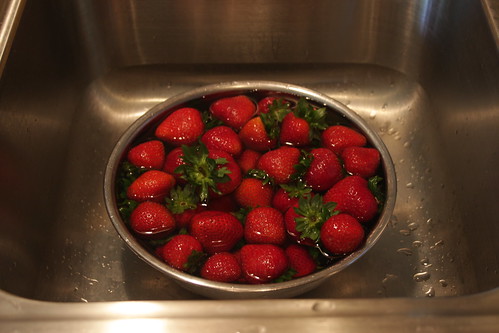
Wash...


...and hull strawberries.


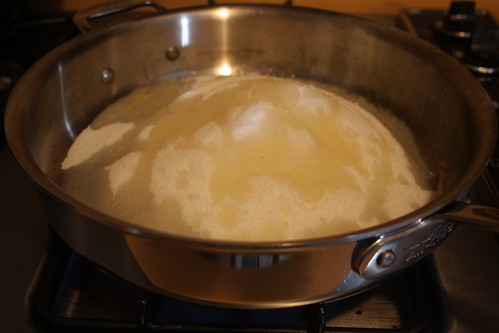
Pour lemon juice over sugar in a deep skillet.
Bring to a boil undisturbed.


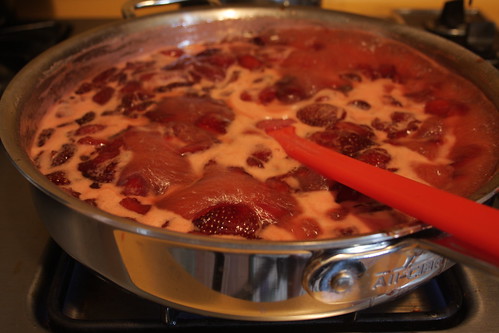
Stir and add strawberries. Bring to a boil and up to 220 degrees for 10-15 minutes.


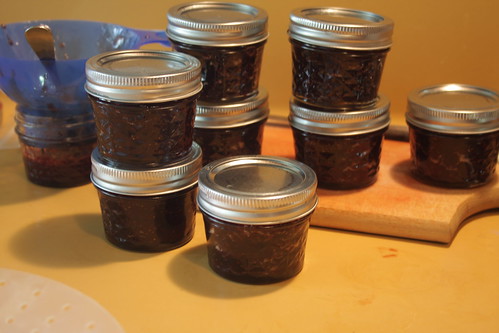
Ladle into jars with 1/4" head space.
Process in a boiling bath for 15 minutes.


The recipe filled nine four ounce jars, leaving just enough to spread over two slices of toast. All I can say, is that the flavor of the preserves was perfectly strawberry and made me as proud as the best meal I have every prepared.

***


I did learn a couple very important lessons:

Do not touch boiling sugar.
Precise temperatures = no pectin.
Do not forget butter - it cuts down foam.
Keep ice on burns as long as possible.


***
The selection at Froberg's was plentiful and saved me from having to choose what else to make. In addition to strawberries, I picked up eggs, okra, and cucumbers. I plan to pickle them in the coming days, so stay tuned.
That is all.

jon.